 Become a member
 Donate
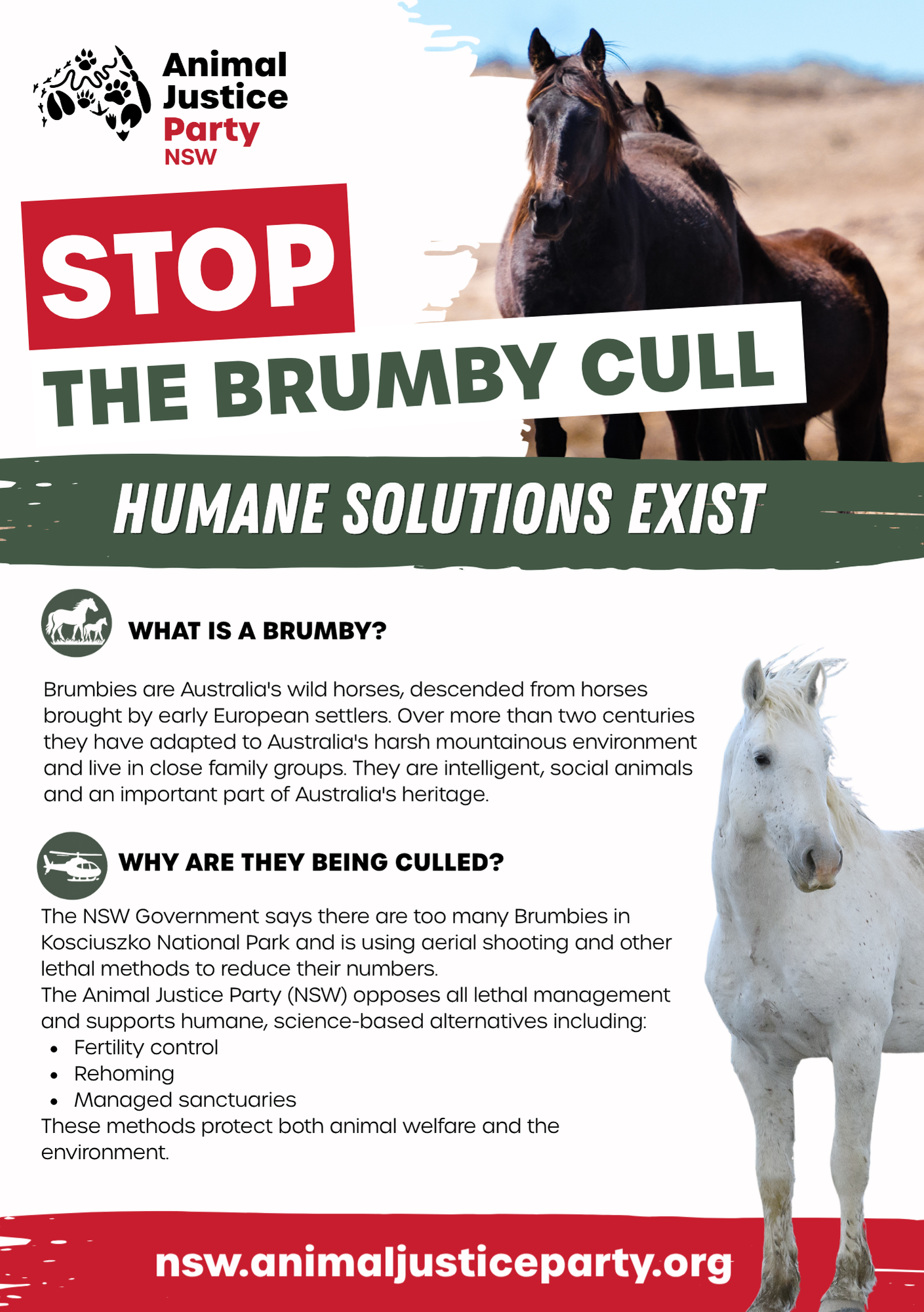
What is a brumby?
Brumby is another name for wild horses in Australia. They are descendants of domesticated horses that escaped or were released by European settlers since their first arrival in 1788. Because brumbies have had to adapt to difficult and often harsh environments, the brumby has evolved into a sturdy, highly intelligent, quick-witted and hardy horse. In the wild, they live in tightly knit family mobs and are highly social and hierarchical. Those who have trained captured brumbies with gentleness and respect, have described them as fast learners, affectionate, hard-working and highly loyal companion horses.
Why are they being culled in Mt Kosciuszko?
The NSW government considers that the number of brumbies living in Mt Kosciuszko National Park is too high and that to protect the alpine ecosystems, their numbers need to be reduced to less than 3,000 horses in the retention zones. The method that has been chosen is aerial culling. That is, running, terrified horses and their foals will be shot from a moving helicopter overhead. The government says that this is the most humane form of lethal control.
The Animal Justice Party opposes any form of lethal management of the brumbies and is committed to supporting proven effective humane alternatives: fertility control, re-homing, and managed sanctuaries.
But why has the culling of brumbies in Mt Kosciuszko National Park become so contentious? Below is our detailed analysis of the key arguments in this debate.
Argument 1: Brumbies are destroying the national park and endangering native wildlife
The claim: Brumby numbers must be reduced to protect sensitive alpine ecosystems and native species.
The evidence against this argument
We do not argue that brumbies are not causing damage to the alpine areas and waterways with their hooves and grazing habits. However, we argue against the ingrained idea that lethal control is the only management method available.
The Snowy Mountains region faces environmental pressures from multiple sources, not brumbies alone:
Infrastructure damage: The Snowy Mountain Hydro 2.0 project has ripped up 10,000 hectares of fragile alpine environment and has caused documented environmental damage, including sinkholes and sediment pollution in national park waterways. The deep tunnelling is predicted to significantly drop the local water table, threatening to dry out high-altitude swamps and creeks.[1]
Tourism expansion: The NSW Government's Snowy Mountains Special Activations Precinct masterplan outlines a key goal to attract year-round tourist visitation to the park, with massive expansion of accommodation, commercial opportunities, sewerage and infrastructure. This means more of the park's land will be torn up for infrastructure, and increased human presence always leads to increased disturbance and destruction of fragile habitat.[2]
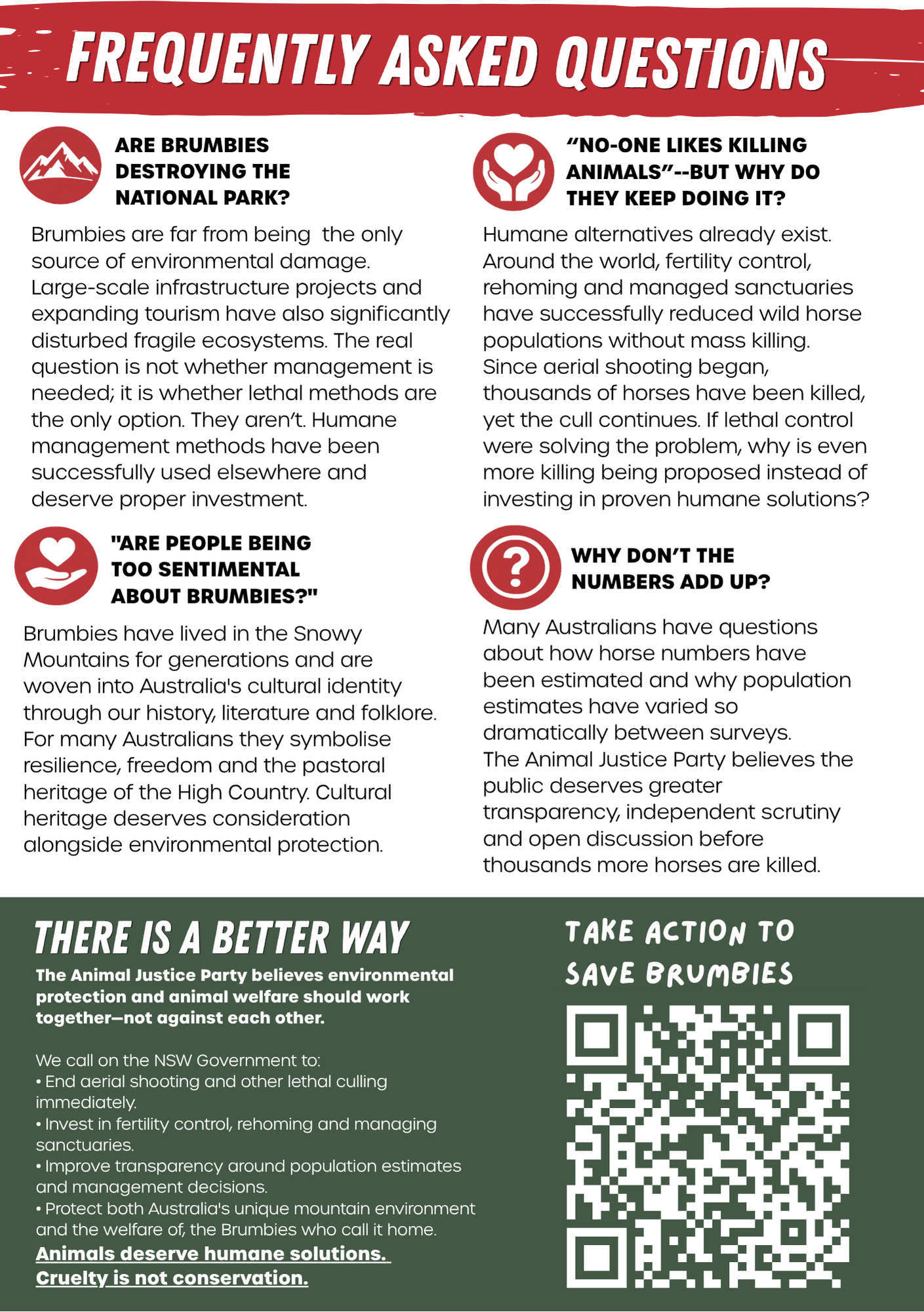
The real question is not whether management is needed. It is whether cruel aerial shooting is the only option. It isn't. Humane management methods have been successfully used elsewhere and deserve proper investment before resorting to mass killing.
Argument 2: "No-one likes killing animals, but it's necessary"
The claim: Lethal control, although regrettable, is the only viable option for managing brumby populations.
The evidence against this argument
Pro-cull advocates use the phrase "no-one likes killing animals" to appear empathetic and suggest that all other options have been explored. According to the Invasive Species Council's own presentation on public messaging for lethal management, this line is "highly effective at cementing participants' support in the campaign." In other words, it is a rhetorical device designed to manipulate acceptance of killing, not evidence that alternatives don't exist.[3]
If we genuinely don't like killing animals, then we should not. Humane alternatives already exist:
- Fertility control has been used successfully in wildlife populations internationally and overcomes previous technical limitations
- Rehoming programmes have relocated wild horses in multiple countries
- Managed sanctuaries provide long-term homes for wild horse populations
The aerial culling evidence: Since 2023, over 6,000 horses have been killed through aerial shooting in Kosciuszko. Yet culling operations continue and are planned to escalate further in November 2026.[4] What this demonstrates is that lethal control is not solving the problem. The NSW Government's own data shows that brumby populations have rebounded rapidly after previous aerial programs.
If shooting was effective at managing populations long-term, why is even more killing being proposed instead of investing in proven humane solutions?
Argument 3: Prioritising brumby heritage is "fictitious mythology"
The claim: Cultural heritage arguments for brumby protection are sentimental and should not influence management decisions.
The evidence against this argument
The Alpine and sub-alpine region, of which Kosciuszko National Park is part, has a long history of pastoral occupation dating back to the 1840s. Brumbies are recognised as the hardy and highly intelligent descendants of those horses who either escaped or were released during hard times.
For many Australians and those who live in the Snowy Mountain region, brumbies represent the history of the region—of stockmen, hardship, adaptability, ruggedness and freedom that the Australian bush has come to represent in our collective identity and character.
This cultural significance is not arbitrary:
- Australian literature and film capture this aspect of our identity—from Banjo Paterson's "The Man From Snowy River" to Elyne Mitchell's "The Silver Brumby" series
- The management plan for Kosciuszko National Park explicitly acknowledges that one of its purposes is to "conserve cultural heritage values"[5]
- An official cultural heritage assessment recognises brumbies as a living cultural heritage that warrants protection[5]
For many Australians, brumbies are a living cultural heritage—the legacy of an Australian pastoral, cultural and social past that has all but disappeared. They deserve to be valued and preserved in the region where they have lived for generations, not slaughtered because government policy makers refuse to invest in alternatives.
Argument 4: Government transparency and population estimates
The claim: Population estimates are scientifically sound and justify the scale of culling operations.
The evidence against this argument
Many Australians have serious questions about how brumby numbers have been estimated and why population figures have varied so dramatically between surveys. These are legitimate concerns about government transparency.
The counting methodology issue: According to methodology reports, only 819 horses were directly sighted during surveys. Whilst, understandably, there would be difficulty counting each horse in a national park of such size with rugged terrain, it seems questionable to extrapolate from 819 sighted horses to an estimate of 6,476 to 16,411 horses that haven't been observed.[4]
Unexplained population growth: In 2024, the NSW Government published that brumby numbers were between 2,131 and 5,639. In 2025, estimates jumped dramatically to between 6,476 and 16,411, explained away as an "improved counting methodology." Yet for such extraordinary population growth to occur between surveys would require every horse, including stallions, to have given birth to a foal and no horses to have died. This defies biological reality.[4]
The Hydro compliance connection: Kosciuszko National Park management is required to offset damage caused by the Snowy Mountain Hydro 2.0 project. The NSW Government has pledged to improve the biological diversity of the park as compensation. Some have questioned whether the urgency and scale of the brumby cull is being driven by these compliance obligations to make brumby removal an "environmental benefit" that offsets Hydro project damage.[1]
Government accountability: The public deserves greater transparency about how population estimates are calculated, what assumptions underpin them, and how management decisions are made. Policy this consequential should not be driven by figures that cannot withstand scrutiny.
There is a better way
The Animal Justice Party (NSW) believes environmental protection and animal welfare should work together, not against each other.
We call on the NSW Government to:
- End aerial shooting and other lethal culling immediately
- Invest in fertility control, rehoming and managed sanctuaries
- Improve transparency around population estimates and management decisions
- Protect both Australia's unique alpine environment and the welfare of the brumbies who call it home
Animals deserve humane solutions. Cruelty is not conservation.
Information Flyer
Sources:
1. National Parks Association of NSW, ‘Failures of Environmental Compliance in the Snowy Mountain 2.0 Project’, 12 April 2024, https://npansw.org.au/wp-content/uploads/2024/04/NPA-Review-of-S2.0-environmental-performance-120424-1.pdf
2. National Parks and Wildlife Service (2006), Kosciuszko National Park: Amendment to the Plan of Management Snowy Mountains Special Activation Precinct. https://www.environment.nsw.gov.au/sites/default/files/kosciuszko-national-park-snowy-mountains-special-activation-precinct-amendment-220298.pdf
3. Invasive Species Council (19 October 2023), ‘How To Get People To Accept Lethal Control f Invasive Species’, https://vpmsymposium.com.au/base/wp-content/uploads/presentations2023/Jack%20Gough.pdf
4. NSW Government, Environment and Heritage, ‘Kosciuszko Wild Horse Survey Shows More Work Needed to Protect National Park’, 22 May 2026, https://www.environment.nsw.gov.au/news/kosciuszko-wild-horse-survey-shows-work-needed-protect-national-park
5. Melville, G., Johnston, C., Doyle., H & McLay, C, (December 2015), ‘National Cultural Heritage Values Assessment and Conflicting Values: The Wild Horse Population of Kosciuszko National Park’, prepared for NSW National Parks and Wildlife Service , https://www.environment.nsw.gov.au/sites/default/files/national-cultural-heritage-values-assessment-conflicting-values-report-2015.pdf
6. NSW Government, Environment and Heritage (22 May 2026), ‘Kosciuszko Wild Horse Survey Shows More Work Needed to Protect National Park’, https://www.environment.nsw.gov.au/news/kosciuszko-wild-horse-survey-shows-work-needed-protect-national-park
7. Jack Gough (20 June 2026), ‘Opinion: Horse sense has left the sable’, Invasive Species Council, https://invasives.org.au/media-releases/opinion-horse-sense-has-left-the-stable/


